The Shrine Project 02
MAY 2024: A year after I first built my shrine I realised it was not ‘working’. Why was I not using it? Over the next few months I began to redesign both the shrine itself and the way I integrated it into my life. Simply looking at the shrine whenever I felt like it was not enough. I had to invent a ritual…
I did not come from a background that practiced ancestor veneration but I also did not want to assume someone else’s traditions. But as I continued to experiment with my own shrine I found that I was rediscovering the value of many traditional practices from the ground up.
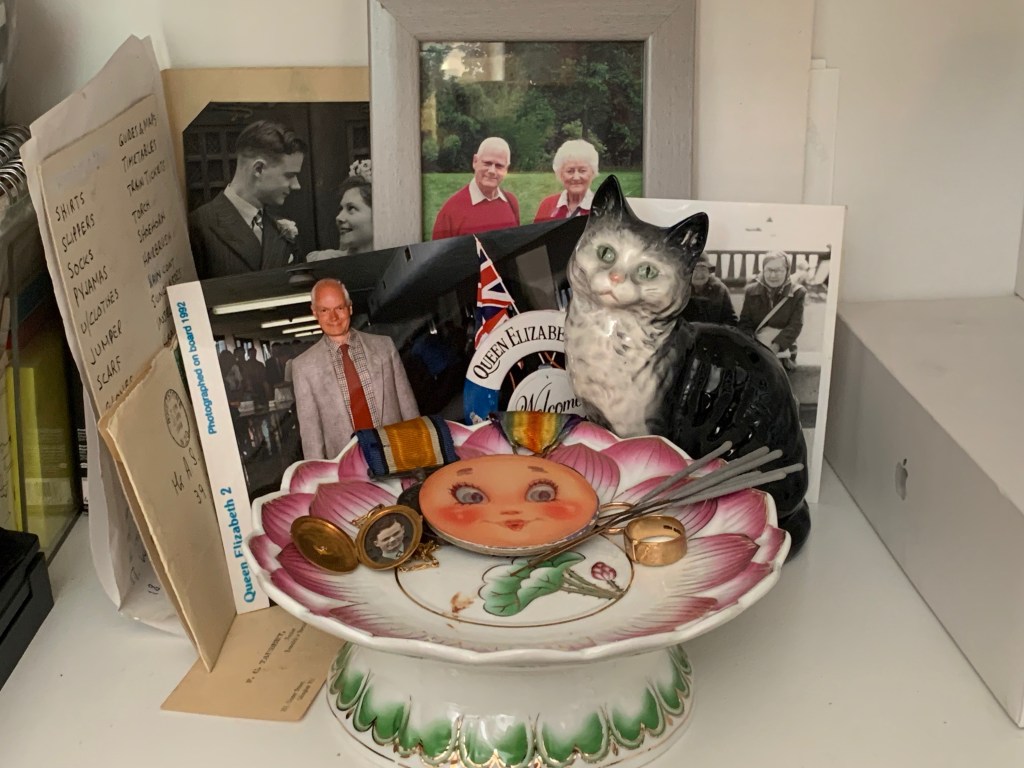
Items on the offering bowl…
- My maternal grandfathers WWI medals
- Sparklers that my father used to make Christmas sculptures
- My mother and fathers weddings rings
- A heart locket with a picture of my father inside
- An animated face that may be from my childhood or possibly my mothers
Items in the background…
- Photo: my parents wedding photo
- Photo: my father and his sister, shortly before her death
- Photo: my mother and grandmother at the seaside
- A calling card from my maternal grandfather, a furrier at the time.
- A china cat that was always on our mantelpiece
- My father’s list of places he liked to visit after retirement
My first action was to turn it into a shrine for one person only. Including all sorts of items relating to myself and other family members was making it hard to focus my thoughts on anything in particular. I removed everything and everyone that was was not directly related to my father. This seemed to work much better.
It took me a whole year to find the right photos of my father for his shrine. Apparently Roland Barthes said that when his mother died he searched through boxes of photos but could only find one that seemed to truly be of her. The images that accurately reflect the memories we have of our family members are extremely rare and hard to define. What did people do before they had photography? Were things easier?
In Vietnam the shrine is visited on at least very full moon and every half moon – every two weeks. This is one of the most structured rituals I have come across. This is also accompanied by the burning of incense sticks. The incense sticks control the timing – visitation of the shrine continues from the moment they are lit to the moment they have burnt away. One can remain meditating or praying at the shrine during this time but some busy Vietnamese go and do their household chores and come back when it is close to finishing.
When food is put on a shrine, the ancestors consume it while the incense sticks are burning. After the incense sticks have finished the family eat the food themselves. This is not some way to avoid wasting the food however. The idea is that he food is placed on the shrine to nourish the ancestors with food from our living world. While the ancestors are eating they imbue the food with their own energy from the world of the ancestors. When the family eat the food they ingest that energy. The food is more like a medium through which the living and the dead exchange sustenance from each of their realms.
I still had to invent a ritual for my use of the shrine. It was not enough to have it in a convenient place on the shelf where I could see it easily. It had to become part of a practice.
Placing food on shrines is a very common practice. I found I had to overcome a resistance to putting good food out for the dead – what use was that? Once I started doing it though I realised what the advantages were.
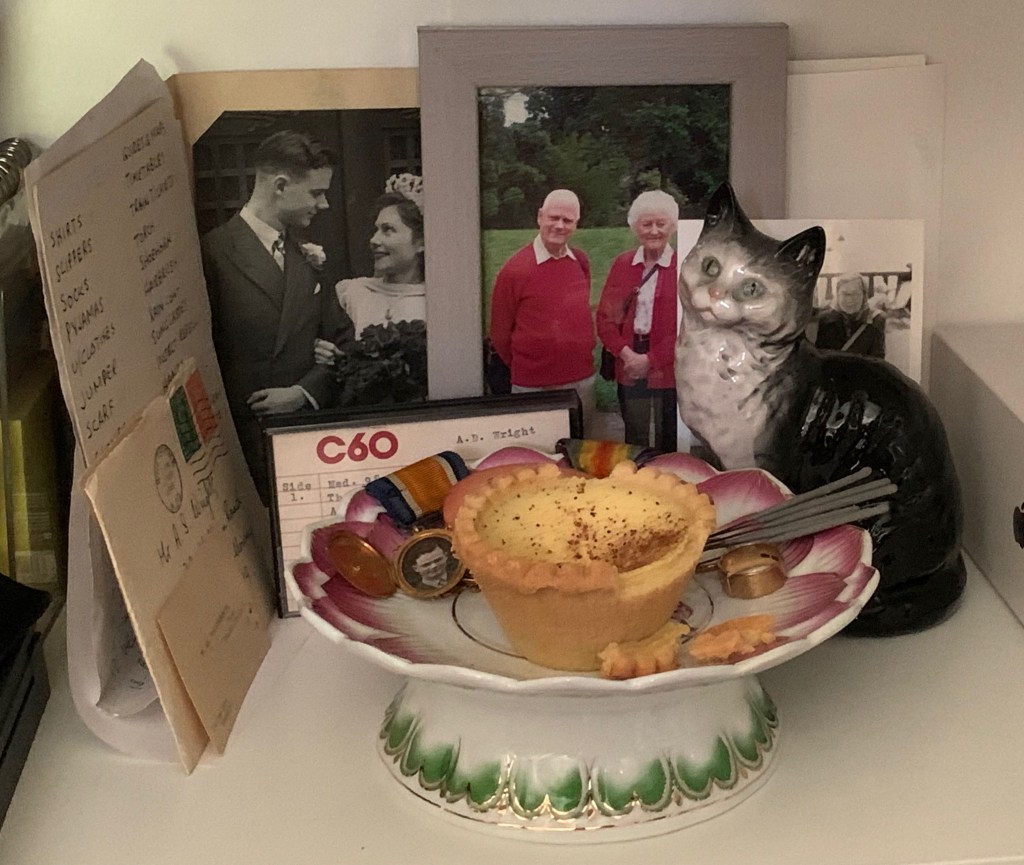
My fathers favourite deserts were custard tarts, apple pies and cream cakes. Fresh cream cakes he seemed to consider like a status symbol or luxury item. I regularly have afternoon tea so one Saturday I bought a box of fresh custard tarts and put one on his shrine while I ate the other.
After putting food on my fathers shrine several things occurred to me…
- leaving food out for the ancestor makes it feel as though they are still part of the family meal
- it keeps the shrine present in your mind – you know you have to return to clear it away
- the food is the only part of the shrine which is transient, all the other items are permanent
- most traditions eat the food at the end of the ritual, but if you do not it becomes sacrificial
 The Posthumous World