Realflow Processing
These are my initial experiments in using fluid simulation to model the decomposition of the body using the visual effects software Realflow.
The question was whether fluid dynamics software would be capable of dealing with larger models up to 10 million polygons, and could animate the detailed interactions between different tissue types, in their transformation from solid to liquid, and under tons of soil. And this does not include important stages such as bloating which might have to be animated entirely differently.
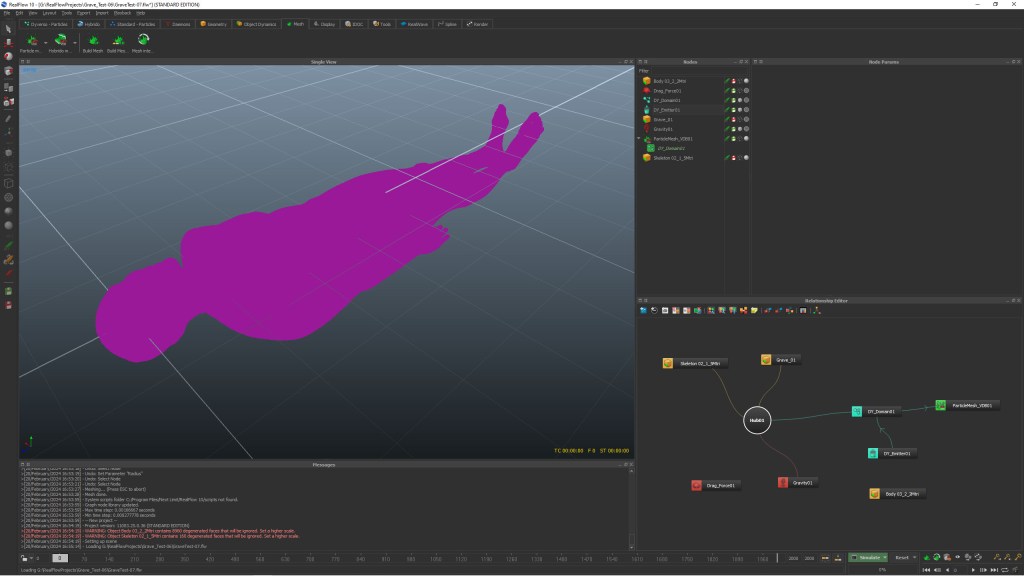
The most complex model I had for testing was the skeleton and the body, both extracted from my CT Scan. That and a box like model of a 3ft deep grave. At this stage there would be no soil interaction, it would be more like a decomposition in a ditch.
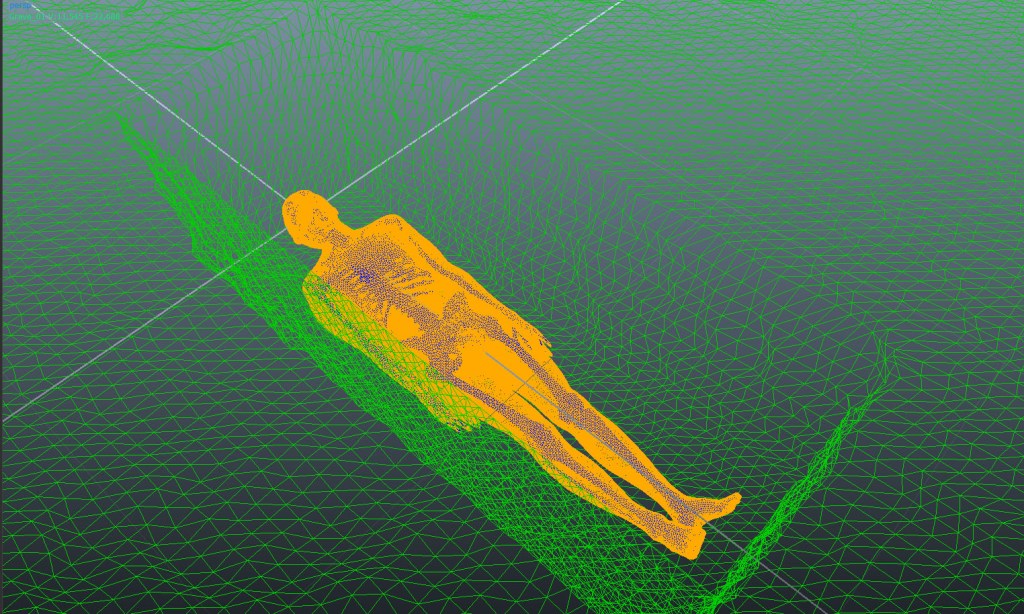
The first tests were to experiment with the software parameters to try to get the effects of a very viscous fluid, more like toothpaste when it was designed for nothing slower than honey. In order to slow it down far enough I had to cheat the physics such as by slowing gravity down to 10%.

Once I had generated the model I needed to make decisions about rendering. There are now plenty of skin renderers but to avoid looking like wax they need good texture maps. I settled on a ‘clay’ material and a wireframe background (reminding me of all those Muybridge studies).
A full model of decomposition would have to include (and this doesn’t include any of the ecological impact):
- the bloating stage
- segmenting the body into all the main organs and tissues types
- texturing everything
- dislocating the bones
- slowing down by about 500 times
- dumping 4 tons of soil on top
The final body model was composed of about 12 million particles. This is compared to the volume of the CT scan which is about 70 to 80 million voxels.
After five or six weeks I managed to get the body to plausibly ‘melt’ over the skeleton and partially reveal it.
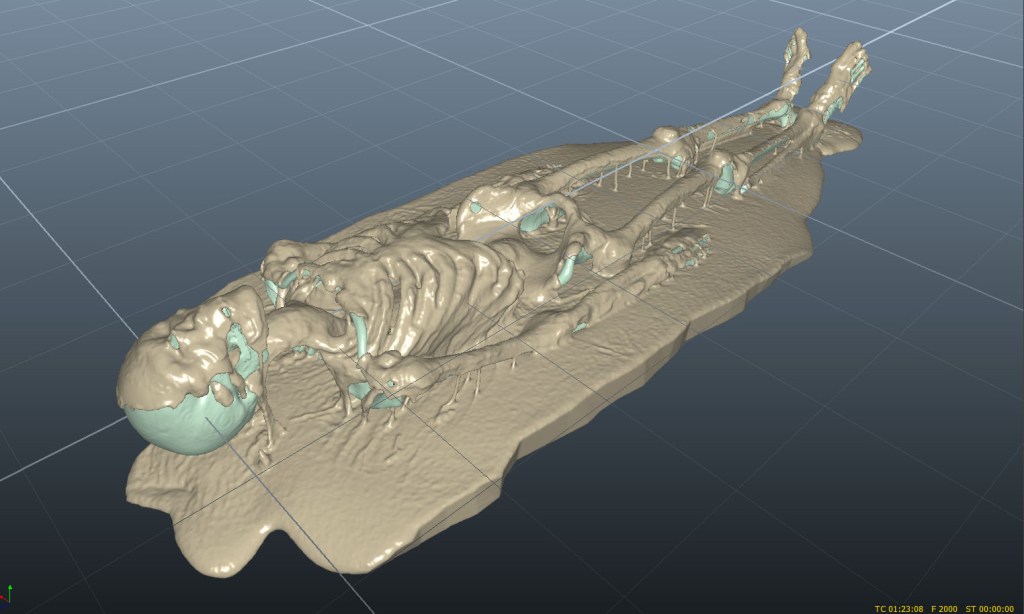
A test to see if a texture would deform with the decomposition.
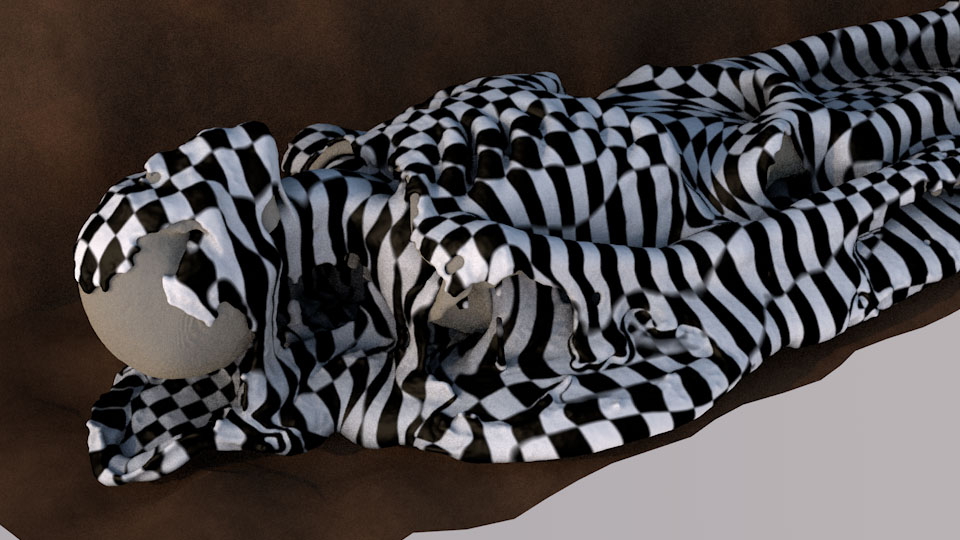
It does not look possible with this kind of software to simply enter the physical properties of each material and expect it to animate automatically. It would have to be more of a visual simulation, using the scientific literature to guide it and using fluids to control the decomposition as an animated effect.
 The Posthumous World